
I am an agricultural economist and PhD candidate in the Agriculture and Resource Economics Department at UC Davis. My research is at the intersection of econometrics, environmental, and agricultural economics. I am currently focusing on the estimation and projection of land use responses to environmental change, methods for empirically measuring adaptation, and health externalities associated with pesticide use.
Before UC Davis, I earned my bachelor’s degree at the University of Waterloo and my master’s degree in Food, Agriculture and Resource Economics at the University of Guelph.
I am on the job market in the 2026-2027 academic year.
Research in Progress
Yesterday Matters: Accounting for Feedback in Acreage Responses to Climate Change
Job market paper
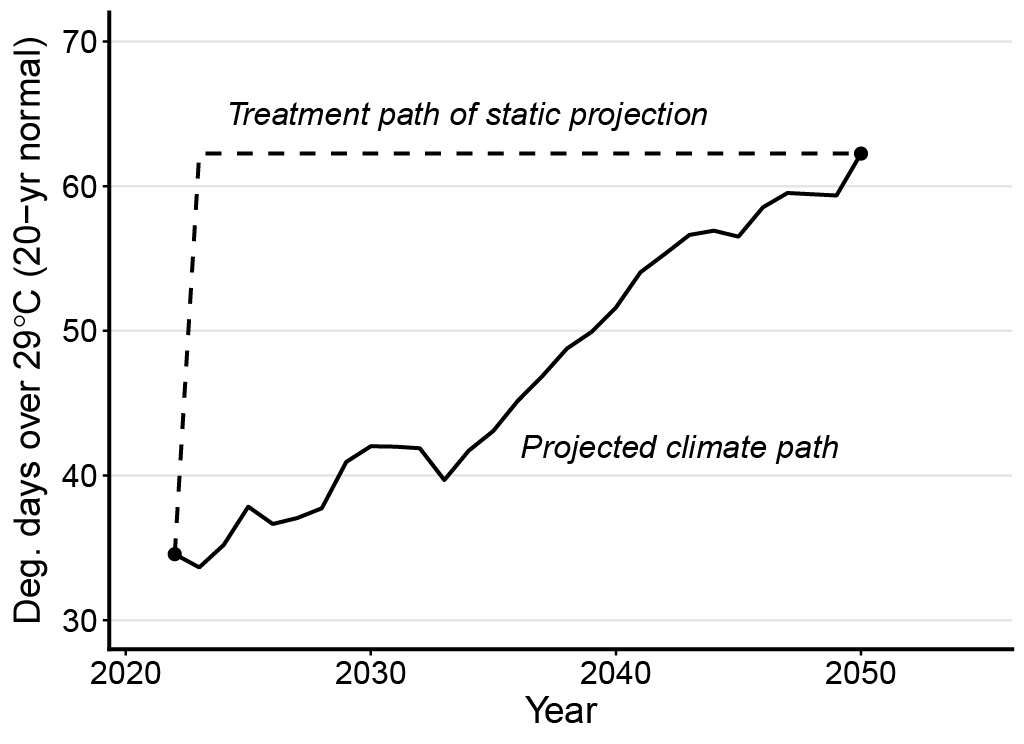
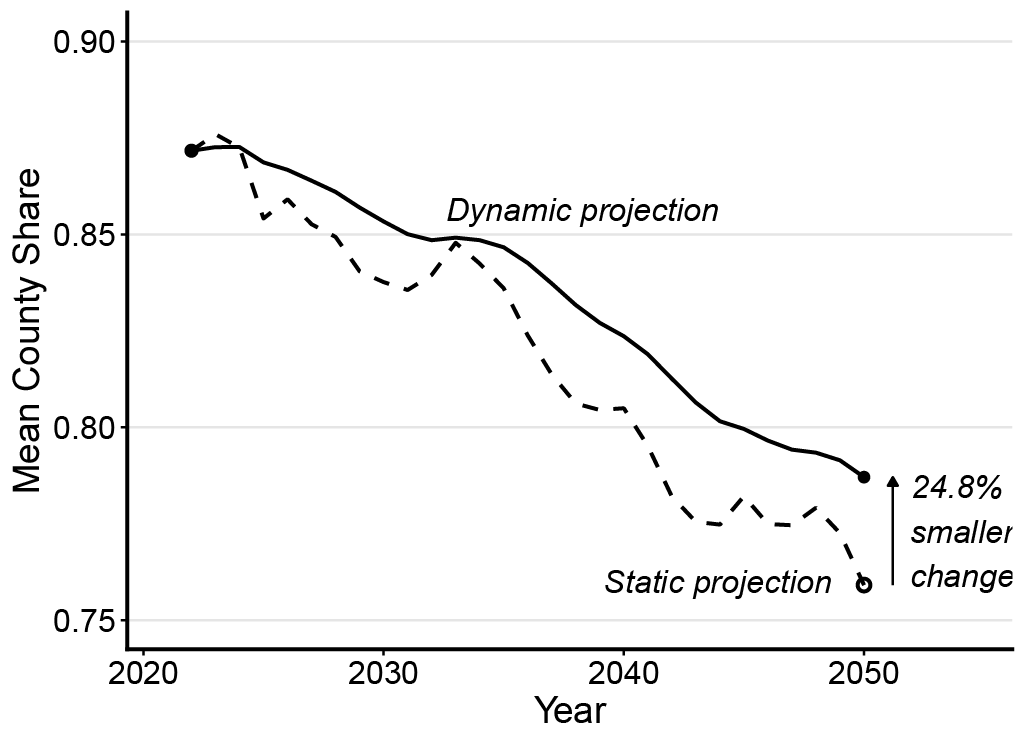
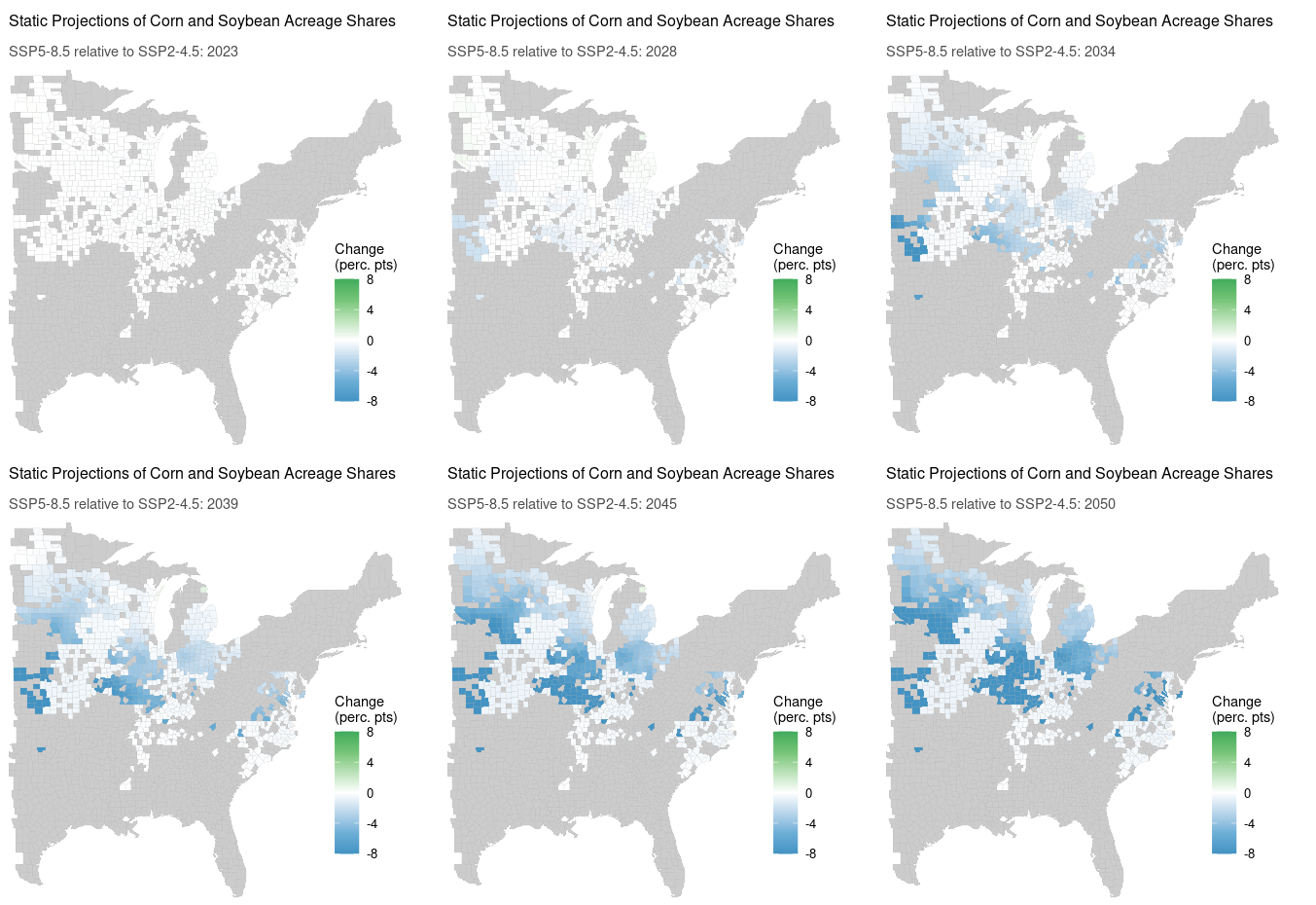
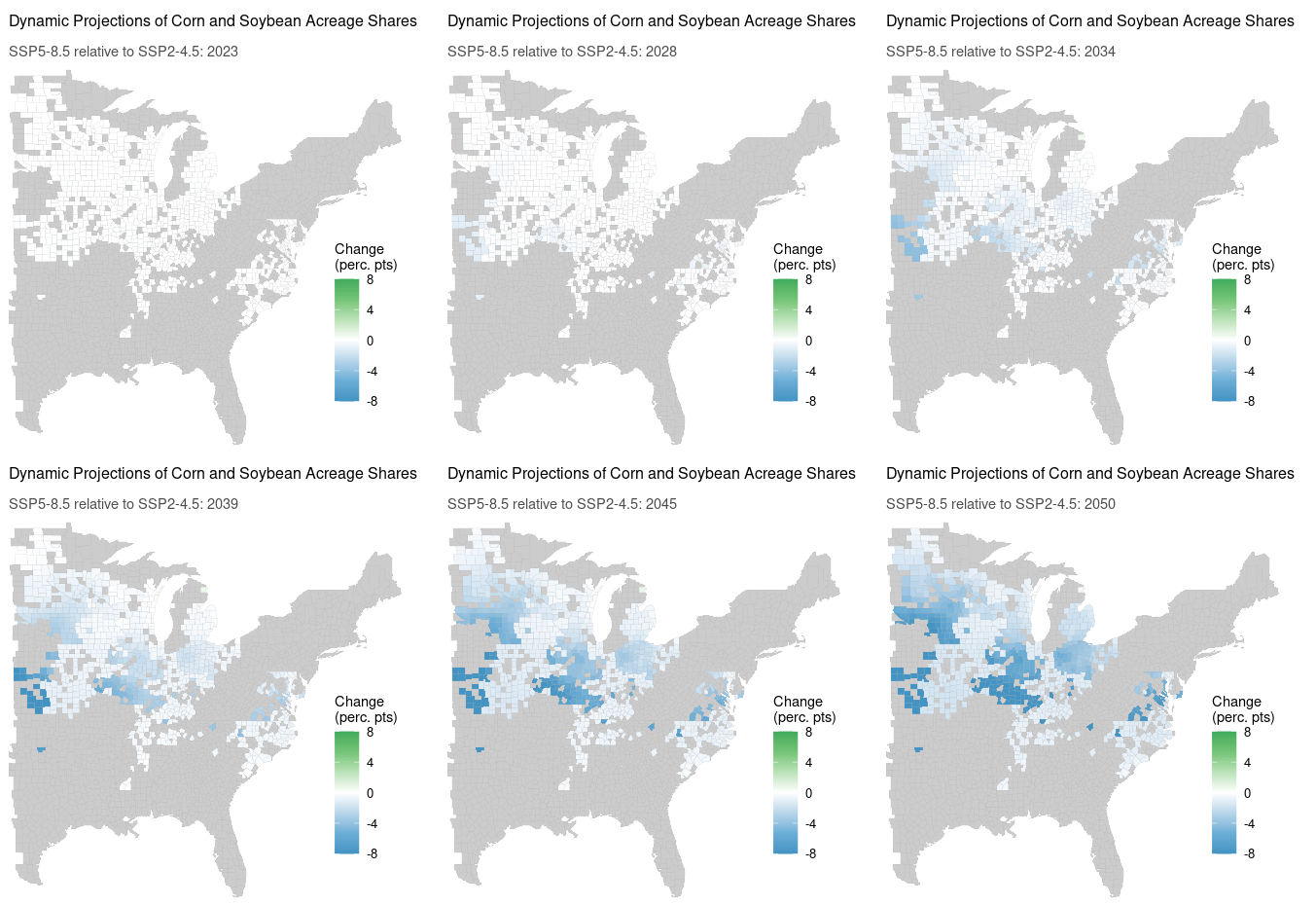
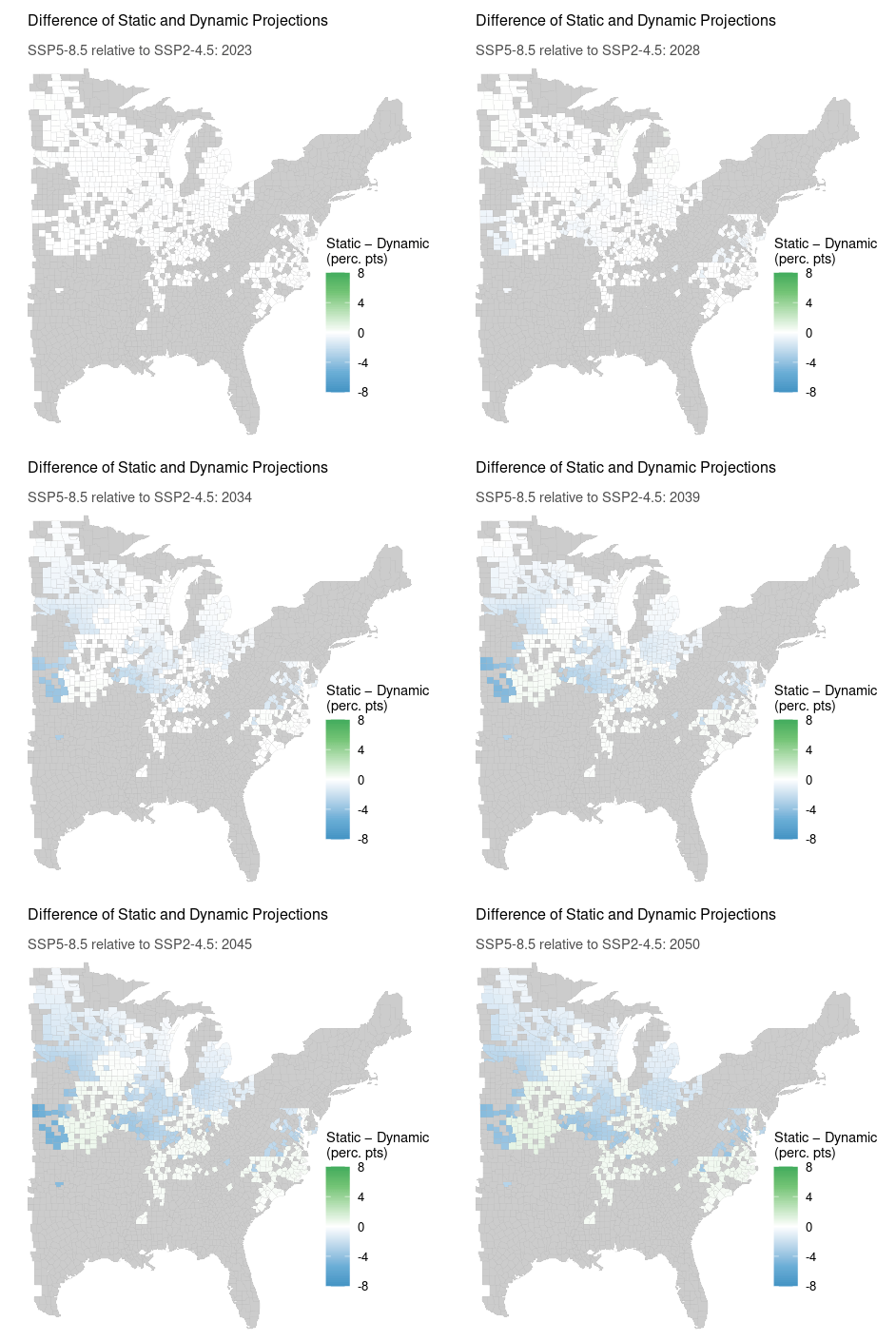
Projections of the potential impacts of climate change on agricultural systems are crucial for developing climate policy. In a dynamic setting where outcomes are persistent, adjustments in response to climate change may be gradual rather than immediate. Using a dynamic panel model that accounts for feedback from lagged allocations, I identify considerable persistence in crop acreage allocations. This persistence has a first-order effect on how climate-change projections should be constructed. Future acreage allocations must account for the cumulative effect of climate along the entire transition path. Existing research often conducts projections using comparative-statics based on models that omit information on past acreage decisions. By disregarding the adjustment path, acreage projections under CMIP6 scenarios with static models overestimate acreage responses by 2050 by an average of 19% and 22% under moderate and high emissions scenarios.
To what extent can long-differencing capture adaptation? — [link]
with Dalia Ghanem and Felix Pretis
Understanding the degree to which we are able to adapt to climate change is central to economic assess- ments of future climate damages. Economists increasingly use comparisons between long differences and fixed effects estimators to measure climate adaptation. We show that such comparisons can be misleading. Neither estimator is consistent for its intended parameter, as both the long-difference (LD) and fixed effects (FE) estimands are weighted averages of the long- and short-run responses to climate and weather. As a result, the difference between the two understates the true extent of adaptation, and the standard test based on this difference –while controlling size – tends to be substantially underpowered in the settings researchers typically encounter. An empirically-calibrated simulation shows this difference understates adaptation by 20–70%, depending on the averaging window.
Pesticide Drift and Prenatal Development: Evidence from 5 million births
with Rachael Goodhue
We estimate the causal effects of pesticide exposure on prenatal health in California. We assemble an individual-level dataset from 2007 to 2017 linking birth outcomes to fine-scaled daily local pesticide exposure. Using quasi-experimental variation in exposure via pesticide drift determined by location-specific wind direction on the day-of-application, we find downwind exposure leads to adverse impacts on birth weight and gestation duration. The detected effects from pesticide drift are consistent with pesticides that exhibit high volatilization.
Publications
Heterogeneity, Yield Distributions, and Climate Change: Implications for Solvency of Crop Insurance Programs — [link]
American Journal of Agricultural Economics (2025)
with Alan Ker
Best Paper Award from the Applied Risk Analysis Section of the AAEA (2025)
Climate change continues to fuel concern about the future cost of publicly-subsidized crop insurance programs in developed nations. These climate changes are expected to alter the upper and lower tails of crop yield distributions differently. This may best be captured by modeling the climate-yield relationship heterogeneously across different parts of the yield distribution. To this end, we consider a mixture model with the component probabilities expressed as nonparametric functions (to capture non-linearities) of weather variables estimated by machine learning methods (neural net). By doing so, we are able to identify possibly heterogeneous effects of climate change on each component, the mixing probabilities, and thus all moments of the yield distribution. We find changing climate alters, quite significantly, the entire shape of the yield distribution. The overall mass of the lower tail tends to increase as temperatures rise, to the point where some yield distributions even become positively skewed. Under the most probable climate scenario (RCP 4.5), the effect of climate on expected losses is small; positive in the short term and negative in the long-term. Importantly, we find differing rates of technological change to consistently raise insurance costs with quicker rates of temperature, relative to the rate of technological change, ameliorating this effect. Overall, the resulting insurance costs from climate are considerably less drastic than previous work due to heterogeneous effects across the yield distribution raising the probability of lower component yields and slowing the rate of technology
Business risk management programs and the adoption of beneficial management practices in Canadian crop agriculture — [link]
Canadian Journal of Agricultural Economics (2024)
with Aaron Delaporte, Tristan Skolrud, Peter Slade, and Alfons Weersink
Canada’s agricultural business risk management (BRM) programs require significant public expenditure, with unclear consequences related to climate change adaptation and mitigation through the adoption of beneficial management practices (BMPs). This study examines the relationship between Canada’s current suite of BRM programs and the adoption of practices that mitigate GHG emissions in crop agriculture. We review the impacts of agricultural insurance on climate adaptation and mitigation, identifying impacts on both the intensive and extensive margins of production. We consider five potential program modifications, including: (1) changes in producer insurance premiums in AgriInsurance for the adoption of practices that would decrease the actuarially fair insurance rate if they were properly incorporated in the calculation; (2) dedicated insurance products related to trials of specific BMPs; (3) adjustments to current programs to allow more whole-farm considerations and intercropping; (4) cross-compliance measures on AgriInvest tied to environmental education; and (5) reduced insurance coverage for unfavorable environmental practices. While the effects of these potential modifications remain uncertain, they will drive the data collection process necessary to ensure that Canada’s BRM programs play an appropriate role in greenhouse-gas reducing BMP adoption and climate change adaptation and mitigation.
Education
- PhD, University of California, Davis (Expected 2027)
- MSc, University of Guelph, 2021
- BSc, University of Waterloo, 2019